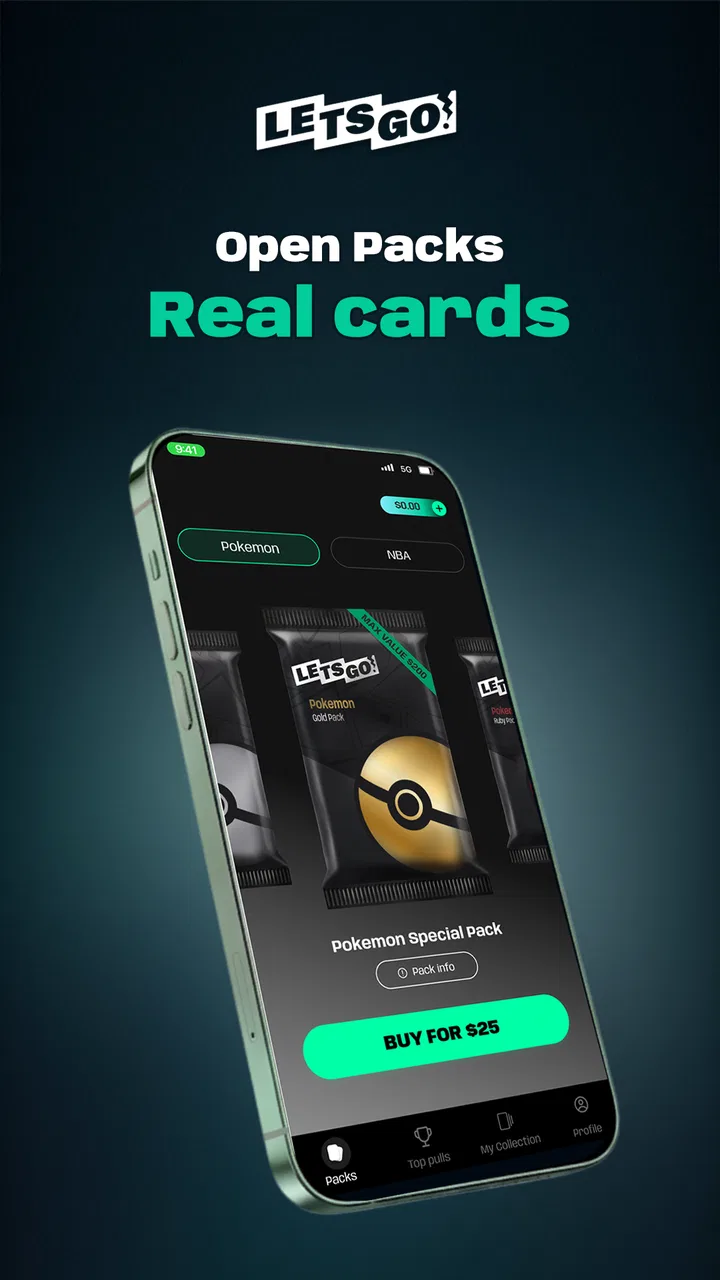
LETSGO: Rip Packs, Real Cards
- 3.3
- Rating
- 50.00K
- Installs
- Free
- Price

 Analysis by App-foxy
I approached LETSGO: Rip Packs, Real Cards as a card game for a household where more than one person might be interested in trading cards, but not necessarily for the same reason. One player may enjoy the surprise of opening a pack, another may care about sports cards, and someone else may be more interested in finding, selling, or organizing cards. That mix is important because this is not simply a traditional card game with matches and a winner. Its focus is the collecting experience around TCG and sports cards.
The basic appeal is easy to understand. You open packs, look for cards worth keeping, and decide what to do with the collection afterward. In practice, that makes the game feel closer to a digital collecting hobby than to a conventional solitaire, poker, or competitive deck-building title. I found that distinction useful when deciding who should try it. If you want rounds with clear rules and a predictable finish, this may not be the right choice. If you like anticipation, browsing, collecting, and making small decisions about virtual items, it has a more natural audience.
How the collecting experience works in a shared household
A realistic use case is a shared tablet or phone used during a quiet evening. One person opens a pack, another watches the reveal, and a third person comments on whether a card should be kept or sold. That kind of participation can make the experience social even when only one account is active. The entertainment comes from the reveal and the conversation around the collection, not necessarily from everyone playing simultaneously.
You May Also Like

 Pandora - Music & Podcasts
Pandora’s Music Is Easy to Start, but Harder to Recover
Pandora’s strength is its low-effort path from a seed to a station. Its weak spot is how much confidence it asks you to place in connection, setup, and quiet recovery.

 AccuWeather: Weather Radar
AccuWeather Review: A Quick, Clear Forecast for Everyday Decisions
For everyday plans, the best forecast is the one you can understand quickly. AccuWeather makes rain timing, radar, and local conditions easy to act on, with a few trade-offs.

 Hill Climb Racing
Why Hill Climb Racing Still Turns Crashes Into One More Run
A tiny car, a bumpy hill and one more upgrade: Hill Climb Racing keeps resurfacing because its simple chaos makes every near-miss feel personal.

 AliExpress - Shopping App
AliExpress Makes Global Shopping Feel Personal, but Shoppers Bear the Risk
AliExpress turns a global marketplace into a pocket-sized discovery engine. Its reach is useful, its shopping loop compelling, and its trade-offs easy to miss.

 Lords Mobile: Kingdom Wars
Lords Mobile Is a Kingdom-Building Routine, Not a Quick Match
A case-by-case verdict on the building, battles, device demands, and social commitments that make Lords Mobile rewarding for some players and exhausting for others.

 PDF Scanner app - TapScanner
TapScanner Makes Paperwork Easier to Capture, Check, and Share
TapScanner makes scanning with a phone feel less like a rescue operation and more like a dependable step in getting work done. Its capture tools are useful, though not flawless.
More From Our News Desk
View All News


That also creates a practical boundary: the collection belongs to the active player, not automatically to everyone watching. I recommend treating the app as an individual hobby even when the device is shared. Before opening packs, agree whose account is being used and who is making the decisions. A child, parent, partner, or roommate may all enjoy seeing the cards, but that does not mean they should assume they can manage the same collection.
The app is free, which makes trying it less complicated than starting a physical card hobby. There is no need to buy binders, sleeves, storage boxes, or individual cards just to discover whether collecting appeals to you. Still, “free” should not be confused with a completely consequence-free activity. Pack opening is designed around anticipation, so I would set a simple household rule before anyone begins: decide how long the session will last and what counts as a satisfying stopping point.
That advice matters especially on a shared device. A person who is only watching may encourage another pack because the reveal is exciting, while the account owner may later regret losing track of the collection. Keeping the session tied to one player and one agreed purpose prevents a casual family activity from turning into an argument about ownership or decisions.
I also like the fact that the concept can suit different levels of involvement. Someone can enjoy the visual reveal without learning every detail about trading cards. A more committed collector can spend time comparing what is already owned and deciding which cards fit the collection. The trade-off is that the app’s appeal depends heavily on your interest in the collecting loop. It is not a substitute for a full card battle game if your priority is strategy against another player.
What to decide before installing it on a shared device
The developer is LETSGO, and the game is listed for Android devices using version 9 or later. That makes the first setup question fairly practical: check which device will host it and whether the operating system meets that requirement. On a family phone or older tablet, it is better to decide in advance whether the app will remain on that device or be used only by one person. A shared screen can be convenient, but it can also blur who is responsible for the account and collection.
I would also choose one primary player before opening the first pack. If several people take turns without a clear owner, the collection can quickly become hard to manage. One person may want to keep every card, another may prefer selling duplicates, and another may simply want to open packs for the reveal. Those are all reasonable preferences, but they are not the same collecting strategy.
A useful arrangement is to make the account owner the final decision-maker while allowing everyone else to offer opinions. That keeps the activity cooperative without pretending that the collection is jointly controlled. For a couple or group of friends sharing a device, the same rule avoids confusion. The person who starts the session should be the person who confirms important actions.
There is another small but valuable setup habit: separate viewing from managing. If a younger household member wants to watch pack openings, let them participate in the discussion, but do not hand over control automatically. This is not a claim that the game includes a particular family feature; it is simply a sensible way to use any collecting app when several people share one screen.
The current version is 1.10.22. I would treat that as a reminder to keep the installed copy current through the normal store process, especially if the app behaves differently after an update. When a collection is important to you, avoid making decisions during a rushed handoff between users. Take a moment to confirm which account and collection are visible before continuing.
Coordinating cards, choices, and expectations
The most interesting household dynamic is the difference between opening and managing. Opening packs is naturally exciting and easy for spectators to understand. Managing the collection requires more patience. Someone has to decide whether a duplicate is useful, whether a card fits the theme of the collection, and whether selling is preferable to keeping it. In my experience, those decisions are where the app can become more personal than the initial reveal.
For a shared session, I would use a simple three-step routine. First, the account owner opens the pack. Second, everyone gets a chance to look at the cards and discuss favorites. Third, the owner makes the final collection decision. This keeps the social part enjoyable while preserving a clear boundary around account actions.
That routine also helps when tastes differ. A sports fan may value a card that a TCG enthusiast ignores, while a completion-minded collector may care about a duplicate for reasons that are not obvious to someone who only wants the most impressive-looking cards. Rather than treating one opinion as objectively correct, use the disagreement to define the collection’s purpose. Is the goal to build a favorite-player group, explore different card types, or simply enjoy the surprise of opening?
The store rating sits at around 3.2 from roughly 140 ratings, with about 80 written reviews. I read that as a reason to approach the experience with measured expectations. The concept is specific and enjoyable for the right person, but it is not likely to satisfy every card-game player. A middling average can reflect the gap between what people expect from the word “game” and what this app actually emphasizes: collecting, opening, shopping, and selling rather than a deep match system.
That distinction is one of the most important things to explain to another household member before they try it. If they expect a competitive battle, they may see the app as limited. If they understand that the pleasure comes from building and handling a virtual card collection, the same design can feel focused rather than incomplete.
For a small group, I would even suggest choosing a theme for each session. One evening might focus on sports cards, while another explores TCG cards. This gives the activity a purpose and makes it easier to stop. It also prevents the common problem of opening packs without remembering what kind of collection anyone is trying to build.
Age, trust, and the mature rating
The game carries a Mature 17+ content rating, so I would not treat it as a general family game for young children. That rating should shape who uses it and how it is introduced in a household. Parents and guardians should review the app’s suitability for the specific teenager or adult who wants to use it, rather than assuming that a card-collecting theme is automatically appropriate for every age.
The age context matters even more when a device is shared. A younger person may see an older sibling or parent opening packs and want to copy the activity, but the rating provides a clear reason to keep access intentional. If several people use the same phone or tablet, decide who may open the app and who may only watch, if watching is appropriate at all.
Trust is also relevant because collecting apps invite personal decisions. I would not let someone else manage a collection unless the account owner is comfortable with that arrangement. This is particularly important when one person is enthusiastic about selling cards and another prefers keeping everything. The disagreement is not a technical problem; it is a household agreement problem, and the easiest solution is to establish the boundary before the first shared session.
I would be careful not to present the app as an educational card-reference tool or as a safe children’s activity simply because it involves sports and trading cards. Its Mature 17+ label should be taken seriously. Adults may enjoy it as a casual hobby, and older users can make their own informed choices, but younger household members need a separate decision from the person who owns the device.
The same caution applies to conversations about value. A card that feels exciting inside the app should not automatically be described to a child as a real-world investment. Keep the language centered on collecting and entertainment. That helps prevent unrealistic expectations and makes the app easier to enjoy for what it is rather than for an imagined financial outcome.
Where it fits beside ordinary card alternatives
Compared with a physical trading-card hobby, the biggest advantage is convenience. You can explore the pack-opening idea without storing cardboard, sorting physical duplicates, or finding a place to keep binders. That makes it attractive for someone who likes the collecting ritual but does not want the cost and clutter associated with physical cards.
Physical cards are still better when the goal is ownership outside the screen, face-to-face trading, or using cards in a tabletop game. A digital collection cannot replace the tactile part of handling cards or the social experience of meeting another collector. If those are the reasons you are interested in trading cards, a local card shop, a physical starter set, or a conventional tabletop title may be a better fit.
Compared with standard mobile card games, this one appears aimed at a different kind of satisfaction. Many card games focus on winning matches, improving a deck, and learning a competitive ruleset. Here, the emphasis is on ripping packs, shopping, selling, and collecting. I would choose it over a battle-focused game when I want a relaxed collecting session, but I would choose a strategy card game when I want decisions that lead directly to a win or loss.
It also differs from a simple digital card album. An album is mainly about viewing what you already have, while this game places more attention on the process of acquiring and managing cards. That creates more anticipation, but it can also make the experience feel repetitive if you are not interested in the acquisition loop itself. The right comparison is not “better or worse”; it is whether you prefer collecting activity or organized display.
One non-obvious trade-off is that convenience can reduce the sense of occasion. Physical pack opening has a deliberate ritual: buying the pack, carrying it home, opening the wrapper, and storing the card. A mobile version is easier to repeat, which is useful for short sessions but may make each individual reveal feel less memorable. I found that setting a theme or a time limit helps preserve the feeling of an event instead of turning it into automatic tapping.
Practical habits that make the app easier to enjoy
My first tip is to define the collection before chasing cards. “Keep everything” sounds harmless, but it quickly removes the need to make choices. A theme gives the collection shape and makes duplicates easier to evaluate. You might focus on a sport, a favorite type of card, or simply the cards that have personal appeal. The point is not to follow a supposedly optimal strategy; it is to make each decision meaningful.
My second tip is to separate excitement from evaluation. Look through a new pack once for the reveal, then return to it later when deciding what to keep or sell. Making an immediate decision while everyone is reacting can lead to choices that do not match the collection’s longer-term direction. This is especially useful in a shared session, where spectators may be enthusiastic but will not manage the collection afterward.
My third tip is to use the selling option as a management tool rather than as the purpose of every session. Selling can help keep the collection focused, but if the only objective becomes finding something to sell, the hobby may start feeling like a repetitive task. I would alternate between exploration and organization: open packs when you want discovery, then review the collection when you want a calmer activity.
Another useful habit is to keep the account owner present during any session involving decisions. That sounds obvious, but shared devices often encourage people to continue from the last screen without checking who was using the app. A quick confirmation avoids accidental changes and keeps the household agreement intact.
I would also avoid using the app as a substitute for a family game night if the group wants equal participation. One person’s account and collection remain central, so the experience naturally gives that person more control. It works better as a hosted activity, where one player manages the collection and others contribute reactions, suggestions, and conversation.
Who should try it and who should skip it
I think the game is best for adults and older users who enjoy trading-card culture but want a low-clutter way to explore it. It can also suit someone who likes browsing and collecting more than competition. The free price makes experimentation straightforward, and the combination of TCG and sports cards gives the concept a wider appeal than a collection tied to only one card scene.
It is less suitable for a young child because of the Mature 17+ rating, even if the subject matter initially sounds familiar. It is also a weak choice for someone who wants a complete deck-building system, live matches, or a strong sense of tactical progression. Those players should look toward a dedicated battle card game instead.
I would skip it as well if your household cannot agree on account boundaries. A shared device is not automatically a shared collection, and the app will not solve disagreements about who gets to keep, sell, or organize the cards. Establishing that arrangement matters more than trying to make every session communal.
The install base is over 50 thousand, so there is enough interest for the concept to have found an audience, but I would still view it as a focused niche game rather than a universal recommendation. Its strengths are tied to the collecting loop, and that means personal taste has a larger role than it does in a broadly accessible puzzle or action title.
My household verdict
After looking at the app through a shared-device lens, I see LETSGO: Rip Packs, Real Cards as a casual collecting experience that can create good conversation, provided one person remains responsible for the account. The pack-opening idea is easy to share, while the collection-management decisions need clearer boundaries. That balance makes it more suitable for a short hosted session than for an unrestricted family activity.
I appreciate that it brings TCG and sports-card collecting into a compact mobile format. It removes physical clutter, lets newcomers explore the hobby, and gives experienced collectors a familiar kind of decision-making around opening, keeping, shopping, and selling. At the same time, the experience may feel narrow if you expect battles, detailed strategy, or the physical satisfaction of real cards.
My recommendation is cautious but positive: try it if the collecting ritual sounds more appealing than winning matches, and decide beforehand who owns the collection on a shared device. Keep the Mature 17+ rating in mind, make the account boundary explicit, and use themes or planned sessions to avoid mindless pack opening. For the right older player, it is a convenient way to enjoy the anticipation of card collecting without filling a room with boxes and binders.
For my own household recommendation, I would present it as a personal collecting hobby that can be enjoyed socially, not a jointly owned family game. That description sets the right expectations. If everyone understands that distinction, the app has a fair chance to be entertaining; if the household is looking for equal turns, competitive matches, or a child-friendly activity, another card game would be the better choice.
FAQs for LETSGO: Rip Packs, Real Cards
01What is LETSGO: Rip Packs, Real Cards?
LETSGO: Rip Packs, Real Cards is a digital collectibles experience focused on opening virtual card packs and discovering cards connected to real-world collecting. The app is designed for users who enjoy the excitement of pack reveals, card rarity, and building a personal collection. Before downloading, remember that availability, card types, rewards, and collecting features may vary by region and can change through app updates.
02How does opening packs and receiving cards work?
After entering the app, users can browse available packs, review the information provided, and open packs to reveal their contents. The experience is built around surprise and collection progress, so results may differ from one opening to another. Some packs or features may require in-app purchases, and users should carefully check the displayed price, contents, eligibility rules, and any limits before confirming a transaction.
03Are the cards in LETSGO physical cards or digital collectibles?
LETSGO presents a connection between pack-opening gameplay and real cards, but the exact format of each item depends on the specific product or promotion. Some cards may be represented digitally inside the app, while certain offerings may involve physical cards or fulfillment options. Read the individual pack description and the service’s terms carefully to understand ownership, delivery, redemption, shipping costs, and regional restrictions.
04Does LETSGO: Rip Packs, Real Cards cost money to use?
Downloading the application may be free, but some packs, entries, upgrades, or collectible-related services can involve real-money purchases. Because pricing and available offers may change, review the purchase screen before completing an order. If children use the app, parental controls and purchase authentication are especially important. Also check the refund policy, supported payment methods, taxes, and whether recurring charges are involved.
05Is LETSGO safe and suitable for children?
The app may be enjoyable for collectors, but users should approach pack-opening mechanics responsibly because randomized rewards can encourage repeated purchases. Check the age rating, privacy policy, community rules, and account requirements before signing up. Avoid sharing sensitive personal information, and use official app-store download links only. Parents should supervise younger users and disable unauthorized purchases through Android or iOS device settings.
Pros
- Exciting pack-opening animations make collecting feel rewarding.
- Real card ownership adds value beyond the digital experience.
- Simple interface makes browsing collections quick and convenient.
- Regular releases can keep the card catalog feeling fresh.
- A good option for collectors who enjoy surprise-based openings.
Cons
- Pack results depend heavily on luck
- which may frustrate some users.
- Rare cards can encourage repeated purchases and higher spending.
- Card availability may vary by region or release period.
- The app may feel limited for users who prefer direct card trading.
- A stable internet connection is needed for most core features.

LETSGO: Rip Packs, Real Cards
Gallery